"It's a beautiful piece of work. It's art - not just a structure."
Margaret Magnus
By Margaret Magnus
The design process for the Darshan Courtyard evolved over the years following the 1985 fire that destroyed the original Baba Room where Avatar Meher Baba gave darshan (the grace of seeing or being with the Divine) to His followers in 1956.
“The fire preserved the fireplace and chimney of that room,” noted former board member Bing Heckman. “And about 15-feet to the right (facing toward the Ojai Valley) was the bay window and the spot where Meher Baba sat during His visit.”

AGNES BARON & AVATAR MEHER BABA sitting in front of the bay window of the Baba Room in the guesthouse at Meher Mount on August 2, 1956. The window looks north to the Ojai Valley. The guesthouse was completely destroyed by the 1985 New Life Fire. The only remaining artifact is the chimney and flagstone fireplace that was in the room.
This fireplace and chimney – known as Baba’s Fireplace – remained throughout the years as a touchstone of Meher Baba’s visit.
Through many discussions and designs, the intention always was to commemorate the space around Baba’s Fireplace in remembrance of Meher Baba’s time at Meher Mount.
“My late husband, Byron Pinckert and I started working on designs and master plans with Meher Mount in 2007,” noted designer and architect Nancy Pinckert.
“Byron talked about Meher Mount being a gateway to the Divine and how certain places at Meher Mount are keys to that gateway – and the fireplace is one of those keys.”
“The Darshan Courtyard is important, because it is a place where the Divine was experienced,” she continued. “And in designing the courtyard, it was really important to keep that concept in mind.”
In addition, Byron wanted to create a canopy for the courtyard that would reflect the canopy of Baba’s Tree – another touchstone of Meher Baba’s visit.
In creating the final design for the project, Nancy designed an unusual, one-of-kind-layered roof.
“The reference to Baba’s Tree is reinforced by the unique two-wing roof structure of the courtyard,” noted Sam Ervin, board president.
The roof has two planes, and “those two planes are almost like hugging,” Nancy explained. “They seem to be going around the chimney but releasing the chimney so that the chimney can be itself, and the courtyard can be itself.”
“It’s a beautiful piece of work. It’s art – not just a structure,” said the contractor Alonzo Banuelos, owner of Hybrid Construction, builders of the Darshan Courtyard.
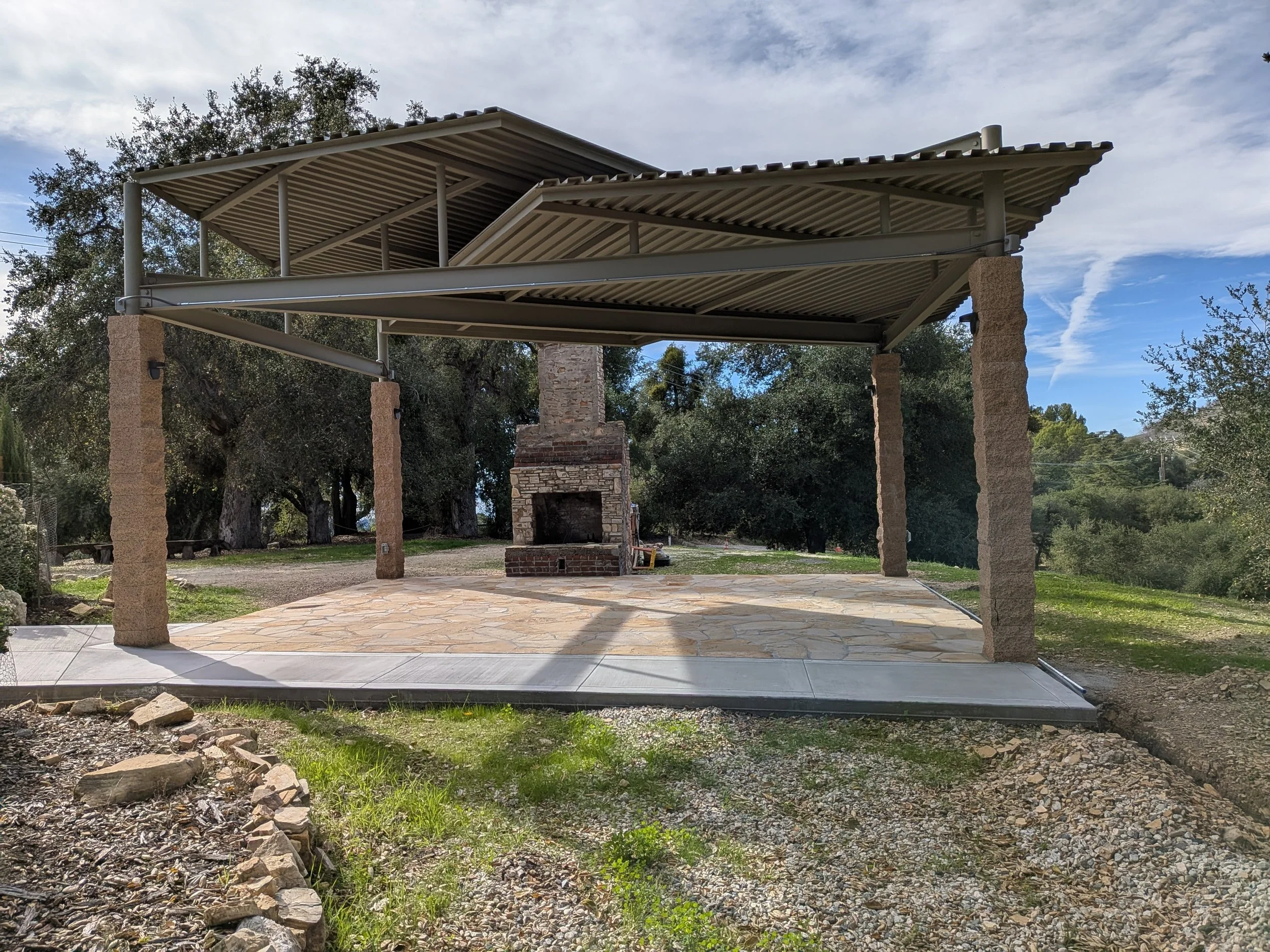
THE DARSHAN COURTYARD and Baba's Fireplace. It's made of concrete block and steel with a flagstone floor - all are fire resistant materials. (Photo: Nancy Pinckert, December 2025)
Not everyone was as enthusiastic.
“I was actually resistant to the Darshan Courtyard,” said resident caretaker Ray Johnston. “I felt it would obscure something pure that already existed – the openness, the flow, the feeling” of the area.
But as construction progressed, and all the elements came together, Ray found that courtyard wasn’t contradictory in any way.
“The design of the Darshan Courtyard opens itself not only to something that we can physically touch, but also to something that moves through it,” he said.
The open design creates “a portal to the past. It gives us a tool to interpret the past and its meaning and importance as part of Meher Mount since its inception,” Ray noted.
“And at the same time,” he continued, “it feels very contemporary and adds to our ability to interpret what’s happening in the present. So, it’s a touchstone in many ways to the past. But it is also a bridge to the present.”