MEHER MOUNT

9902 Sulphur Mountain Road
Ojai, CA 93023-9375

Phone: 805-640-0000
Email: info@mehermount.org

HOURS

Wednesday-Sunday: Noon to 5:00 p.m.
Monday & Tuesday: Closed

MANAGER/CARETAKERS

Buzz & Ginger Glasky

BOARD OF DIRECTORS

Sam Ervin, Preident
Ron Holsey, Vice President
Ursula Reinhart, Treasurer
Jim Whitson, Director
Richard Mannis, Director

OFFICERS

Margaret Magnus, Secretary

Form Block
This form needs a storage option. Double-click here to edit this form, and tell us where to save form submissions in the Storage tab. Learn more

9902 Sulphur Mountain Rd
Ojai, CA, 93023
United States

(805) 640-0000

Photo Friday Blog

Filtering by Category: Nature

"When I became a lover I thought I had gained the Pearl..." - Hafiz

Meher Mount

Your Friday photo…

“After a day of fierce winds and pouring rains, this sunset appeared like a pearl over the mountains beyond Meher Mount,” noted photographer Kristina Somma. She was reminded of the following passage from Hafiz.

When I became a lover I thought I had gained the Pearl of the God; foolish I did not know that his Pearl lies on the floor of an ocean which has innumerable waves to be encountered and great depths to be sounded.
— Hafiz

This quote from Hafiz introduces the discourse “The Pearl Diver’” from The Everything and The Nothing. These 64 discourses were dictated in silence by Avatar Meher Baba through hand signs.

Meher Baba declared:

“I am the One whom so many seek and so few find.”

Meher Baba uses the imagery of a pearl to explain the quest for God.

“In the beginning the seeker of Truth is like a man who, having heard that a priceless pearl is to be got from the depths of the ocean, goes down to the seashore and first admires the vastness of the ocean and then paddles and splashes about in the shallows and, intoxicated with this new excitement, forgets about the pearl.

“Out of the many who do this, one after a while, remembers his quest and learns to swim and starts to swim out.

“Out of many who do this, one masters swimming and reaches the open sea; the others perish in the waves.

“Out of many who practice diving, one reaches the ocean bed and grasps the pearl.

“Out of many who get hold of the pearl, one swims back up to the surface with it, the others stay stuck on the floor gazing with wonder at the pearl.

“Out of many who swim up to the surface, one returns to the shore. This one is the Perfect Master (Qutub) and He shows His pearl to the others — the divers, the swimmers, the paddlers, and so encourages them in their efforts. But He can if He wises cause another to become the possessor of the pearl without that one having to learn swimming and diving.

“But God-Man or Avatar is the Master of Masters (Qutub-al-Aktab), and can give possession of the Pearl to any number He likes.”


Khwaja Shams-ud-Din Muhammed Hafez-e Shirazi (1315-1390) was a Persian lyric poet who was called Hafez or Hafiz (meaning “memorizer”) because he memorized the Quran and the works of other Persian poets.

Hafez primarily wrote in the literary genre of ghazals — Meher Baba’s favorite poetic from. This form is considered by some to be ideal for expressing the ecstasy of Divine inspiration in the mystical form of love poems. Hafiz’s many allusions to wine, drunkeness, and taverns can be understood as allegorical references to the experience of Divine Love.


Source

Meher Baba, The Everything and The Nothing, pp. 20-21. (Myrtle Beach, SC: Sheriar Foundation 2003) ©Avatar Meher Baba Perpetual Public Charitable Trust, Ahmednagar, India.


What if you see a skunk?

Meher Mount

Your Friday photo is in honor of Earth Month and the wildlife at Meher Mount…

Caretaker Ray Johnston’s trail camera caught this nighttime visitor at the pond.

Skunks are normally nocturnal. They spend the day sleeping in burrows and search for food and water in early evening and through the night.

But once in a while, you might see a skunk during the day, particularly if the skunk is a nursing mother looking for food.

This photo of a skunk foraging at Meher Mount during the day was also taken by Ray Johnston.

Skunks are beneficial to farmers, gardeners, and landowners. They are omnivorous and eat a variety of garden pests, including mice, voles, beetles, various larvae, wasps and crickets.

Skunks are also scavengers. They will seek out animal carcasses, which helps keep an ecosystem free of carrion. Scavengers are important to the health of the environment.

If You See a Skunk…

If you see a skunk, remember they have poor eyesight. You can make loud noises, stamp your feet, clap your hands loudly, or just walk away.  

Skunks are generally not aggressive and will only spray if they feel cornered or attacked.

The spray, which comes from two glands near the base of the skunk’s tail, can hit a target 12 feet away. If threatened, skunks stamp their front feet, lift their tail, and growl. Some species of skunk even spring into a handstand before spraying. If the person or animal doesn’t retreat, the skunk aims the spray at the eyes, allowing the skunk to escape. The spray can remain on its target for days.

It may seem ironic, but skunks hate certain odors: citrus, ammonia, mothballs and strong household deodorizing scents.

Striped skunks (Mephitis mephitis) – generally seen in the Southern California ecosystem – are solitary, typically docile animals.

They often live in the abandoned dens of other mammals during the day, or take up residence in hollowed logs, brush piles or underneath buildings. They prefer underground dens in colder winter climates. While not truly hibernating, striped skunks experience extended periods of inactivity during winter.

Male striped skunks breed with multiple females and are rejected by the females after mating occurs. Female striped skunks typically give birth once each year, with breeding occurring between February and April.

~Margaret Magnus, Communications Director


"His vibrations were like a hummingbird."

Juan Mendez

Your Friday photo is in honor of Earth Month and the wildlife at Meher Mount…

You might even see some of these residents during your visit. This photo and the following story are from Juan Mendez, temporary caretaker.

The love just poured out of Him. His vibrations were like a hummingbird. You couldn’t see the vibrations, but you knew the vibrating. You felt that in Baba.
— Agnes Baron on meeting Avatar Meher Baba

Meher Mount’s hummingbirds are a constant reminder of Meher Baba’s eternal presence within us.

When Meher Mount co-founder Agnes Baron met Avatar Meher Baba in 1952 at Myrtle Beach, she recounted her first moments with Meher Baba:

“The love just poured out of him. His vibrations were like a hummingbird. You couldn't see the vibrations, but you knew the vibrating. You felt that in Baba.”

It is not uncommon for visitors at Meher Mount to see and enjoy the beauty of the multitude of hummingbirds that hover and feed from the feeders and plants around the Visitor Center.

A spectacle that is not commonly seen is when the hummingbirds fly through the water spout at the pond to wet their plumage, especially during the hot summer days.

During one of my stays at Meher Mount as temporary caretaker, I was fortunate to capture this moment when a male Anna’s Hummingbird did its fly-over to cool off.

~Juan Mendez, Temporary Caretaker


"It's a sanctuary for all life, large and small."

Ray Johnston

Your Friday photo is in honor of Earth Month and the ecosystem at Meher Mount…

Watering holes are vital to various ecosystems. At Meher Mount, that watering hole is the pond near the Visitor Center. It attracts and sustains a wide variety of wildlife — both day and night — that call the mountain home.

You might even see some of these residents during your visit. Sam Ervin photographed this deer stopping by the pond for a drink of water.

The pond is an essential part of Meher Mount’s role as a sanctuary for all life, large and small. A hub for life in a challenging environment.
— Ray Johnston, Caretaker

Open water is scarce atop Sulphur Mountain in the dry months. So the pond is a lifeline for the many species that depend on having access to an open water source.

This tiny pond is usually alive with birds, insects, and sometimes larger animals.

Nights at the pond are busy and often loud with a chorus of frogs and the sound of nocturnal wings, hooves, and tiny feet running through the leaves.

All are part of the ecosystem at Meher Mount.

~ Ray Johnston


Ecosystem: A community of living organisms (plants, animals and microbes) and nonliving elements interacting with each other and their surroundings (environment) and weather to form a bubble of life.

Natural ecosystems are broadly classified into two types: Terrestrial (land) such as desert, grassland, mountain, rain forest; and aquatic (water) such as ocean, rivers, lakes.


"Ribbit."

Robert Turnage

Your Friday photo…

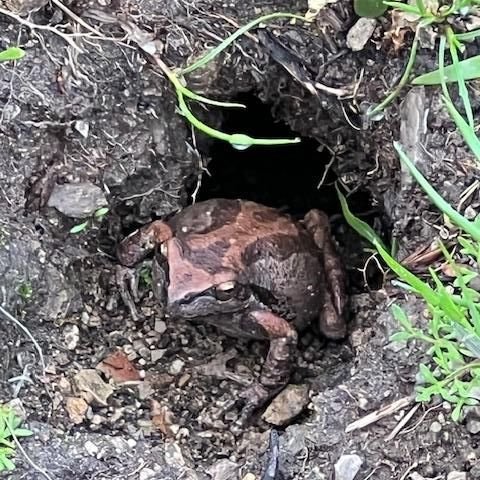
On a walk along Baba’s Path, temporary caretakers Robert Turnage and Kristina Somma noticed a slight movement on the ground. There at the mouth of a gopher hole was a beautiful little frog, almost perfectly camouflaged by its brown color. What a lovely gift.

Ribbit.
— Baja California Treefrog

The Baja California Treefrog is native to the region which includes Meher Mount. The color of a specific frog ranges from tan to brown or green and will most often match the microhabitat it lives in.

Even though Pseudacris hypochondriaca is a treefrog, it doesn’t climb trees and much prefers hanging out near the ground or in low vegetation. Treefrogs are also called chorus frogs.

The call of the Baja California Treefrog is known throughout the world through its wide use as a nighttime background sound in many Hollywood movies, even those which are set in areas well outside the range of this frog.

Here’s the melody from a frog calling at night. It’s the same sound heard at Meher Mount last night.


"They formed a natural harmony..."

Denali Jepson

Your Friday photo…

A bouquet of natural wildflowers was created for the Visitor Center by Denali Jepson and photographed by Ron Holsey, board member.

They formed a natural harmony...
— Denali Jepson, Temporary Caretaker

Ron Holsey and I were taking a hike around the grounds. I kept noticing how many fragrant, picturesque plants and flowers we were surrounded by.

All the colors were perfectly autumn and beautifully varied.

On the way back to the Visitor Center, I picked any that made me go, “Wow look at this one.’” I didn’t even have to arrange them. They formed a natural harmony like they did in the fields. 

I appreciate how beautiful it is to be at Meher Mount.

~Denali Jepson